

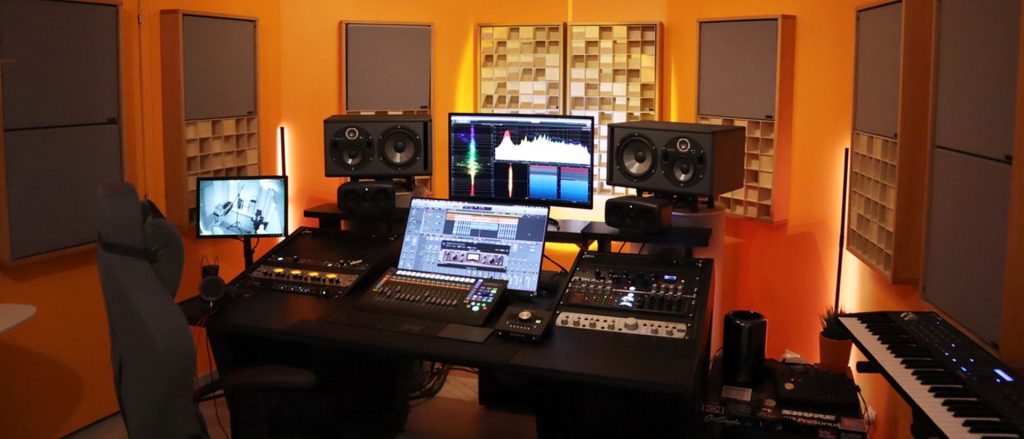
You want to record, produce, mix or master music in your room? In that case, room acoustics are a crucial factor for professional sound.
The acoustic properties of a room matter whenever sound, e.g. from a loudspeaker or instrument, spreads through a room and reaches your ears or a microphone. How the sound behaves in the room is influenced by its acoustics.
Once you begin to explore the topic of room acoustics, you will quickly come across several essential terms. In this article, we will provide you with a comprehensive understanding of room acoustics and explain direct sound, early reflections, reverberation, reverberation time and RT60, standing waves and room modes, flutter echoes, absorption and diffusion – in a straightforward and understandable manner.
Direct sound
The important part of the sound in your studio is what is known as direct sound. This travels directly from the sound source to the receiver via the shortest route. This is the audio signal that you want to hear or capture without any interference.
Any sound that reaches your ears or microphone in addition to the direct sound consists of sound reflections from the walls and surfaces of your room. Very shortly after the direct sound, the early reflections arrive, often referred to as first reflections, followed shortly afterwards by the diffuse reverberation. If there is a significant time delay between the sound reflections and the direct sound, they are referred to as echoes.
For home studios and recording studios in general, a high level of direct sound is essential, and the ambience or room sound, i.e. reflections, must be very well controlled.
Early reflections
As described above, direct sound reaches your ear or microphone via the shortest route. Some sound waves, however, are reflected exactly once by a wall or ceiling before reaching you or the microphone. These sound waves are called first or early reflections.
There is only a delay of a few milliseconds between direct sound and early reflections, and they hardly differ in their sound level. Because of this, early reflections can have a significant negative effect on the sound. They cause so-called comb filter effects and changes in the sound. Speech becomes less clear, music loses its precision, and the perception of spatiality in the stereo image becomes blurred. Early reflections are particularly problematic in small rooms with short distances between the sound source, walls and receiver.
Due to the many negative effects of early reflections, one of the most important aspects of room acoustic optimisation is to reduce the energy of these sound waves and treat the so-called early reflection points with sound absorbers. However, there are also situations in which the use of diffusors in these spots can be beneficial.
Reverberation, reverberation time and RT60
The direct sound has reached our ears, and the early reflections have likewise arrived (hopefully with a sufficient amount of attenuation) – what follows now is the reverberation.
This consists of sound waves that have been reflected multiple times by walls, ceilings, floors, furniture, etc. In the process, they lose energy and become increasingly quieter. Just like a ball that you roll across the floor loses speed due to friction, an acoustic signal also fades away. The duration of this fading or decay is described by the reverberation time.
In this context, we often hear the term RT60. RT60 describes the time it takes for a sound to become 60 dB quieter (which is a reduction by a factor of 1,000!). In large rooms such as churches, factory halls or concert halls, this can take several seconds – in small rooms, this time is significantly shorter.
For mixing, mastering and producing, your room should ideally have a reverberation time (RT60) of 0.15 to 0.3 seconds. When recording, it can be a little longer, depending on the sound you want to capture. An even shorter reverberation time is perceived as rather unpleasant – and requires additional investment in acoustic measures. On the other hand, a reverberation time that is too long results in a diffuse, imprecise sound that makes mixing and mastering more difficult and often results in poor-quality recordings.
The reverberation time (RT60) can be calculated and specifically influenced with acoustic modules – therefore, the comparison of the RT60 before and after room acoustic optimisation is part of the Room Acoustic Planning PRO at HOFA-Akustik.
Standing waves and room modes
You have already learned that sound waves are reflected by the surfaces of your room and thus propagate throughout the room. When waves meet, they interfere with each other.
In the low frequency range, a special overlapping effect occurs in which the sound waves you hear or record vary in volume depending on the position of the listener in the room. This is caused by so-called standing waves. These appear between two or more surfaces in your room, for example between two walls or between ceiling and floor.
To understand the issue of room modes, it is important to know that sound waves have different lengths depending on their frequency. A 20 Hz tone has a wavelength of approximately 17 metres, at 200 Hz it is approximately 1.7 metres, and at 2,000 Hz it is approximately 17 cm.
If reflected waves with the same frequency repeatedly hit each other between two walls, they can be amplified or cancelled out in the room. This results in what are known as standing waves or room modes – two terms that are often used synonymously, even though this is not entirely accurate from a technical point of view.
Standing waves lead to some frequencies being much louder or quieter at certain spots in the room. If you move just a bit, the bass can change a lot – it might be booming in one spot and almost gone in another. This is especially true for low frequencies. Put simply, it occurs below 300 Hz and becomes more pronounced as the frequency descends.
These specific problems are resonances within your room. They depend directly on the length, width and height of the room. Small rooms with parallel walls are particularly prone to strong modes.
You can actually calculate the room modes yourself – click here to access our room mode calculator.
Room modes are a problem when mixing and recording because they compromise the reproduction of bass frequencies. One solution is to change the listening position. In addition, the use of large absorbers, known as bass traps, can counteract standing waves by reducing the energy of these resonances and smoothing the frequency response at the listening position.
Flutter echoes
When sound oscillates rapidly between two parallel, hard surfaces, it can repeat itself at very short intervals. This creates a fast, metallic-sounding echo – known as a flutter echo.
Flutter echoes are usually clearly audible with impulses such as clapping or percussive signals. The sound is harsh, unpleasant and unnatural. Flutter echoes are particularly common in small, untreated rooms with parallel walls, uncovered floors or large windows.
Fortunately, flutter echoes can be effectively controlled with acoustic modules.
Absorption and diffusion
To specifically improve the acoustic properties of a room, two basic principles can be applied: absorption and diffusion.
Absorption means that sound energy is reduced. Porous materials slow down sound waves within their structure. This absorbs energy and shortens reverberation. Broadband absorbers, attached to walls and ceilings, are particularly effective in the mid and high frequency ranges, while large-volume bass traps, often positioned in corners, serve to control low frequencies and reduce room modes.
Diffusion works differently: it doesn’t absorb sound, which means that the sound energy isn’t reduced, but instead scattered in lots of directions. Specifically designed, uneven surfaces cause reflected sound waves to be scattered evenly throughout the room rather than being reflected back in a cluster. Diffusors create a pleasant, lively sound in the room and prevent early reflections and flutter echoes.
In practice, both measures complement each other. While absorption controls the reverberation time, diffusion creates a natural, spatial sound image. A balanced combination of both principles is crucial for precise and pleasant room acoustics.
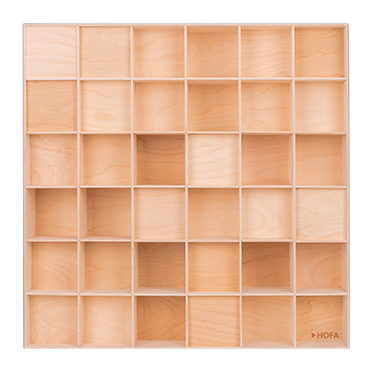
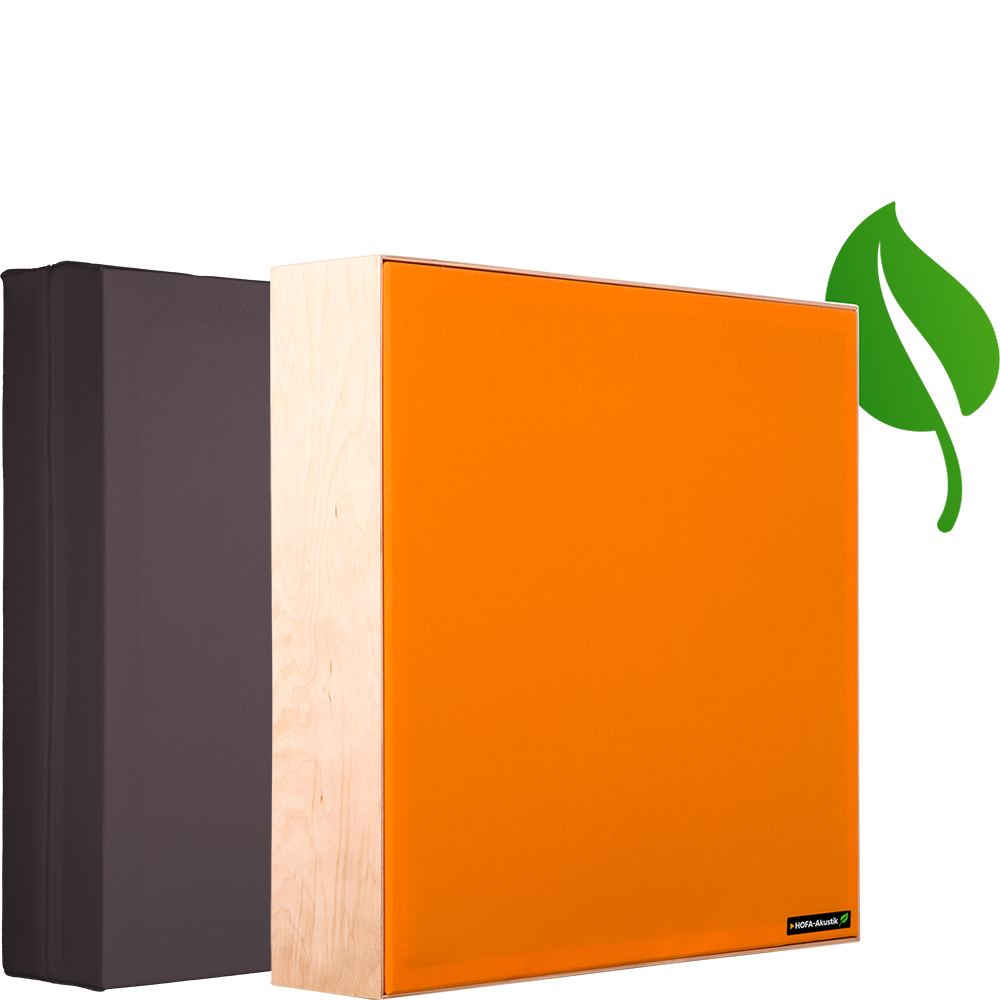
Now you know the most important technical terms in room acoustics and can get to work on your room. Please feel free to contact us if you need help, for example with a room acoustics plan or the HOFA Studio-Line acoustic modules, which are specially designed for studios.