


Anyone looking for room acoustic solutions for apartments or offices today will sooner or later stumble upon thin acoustic panels, often featuring a wood look or made of acoustic foam, which are glued or screwed to the wall. The problem: Most of these elements cannot do what you actually buy them for, because many of these acoustic panels are more decoration than real acoustic solutions. They might look that way, but acoustically, they simply don’t deliver what is needed within your room.
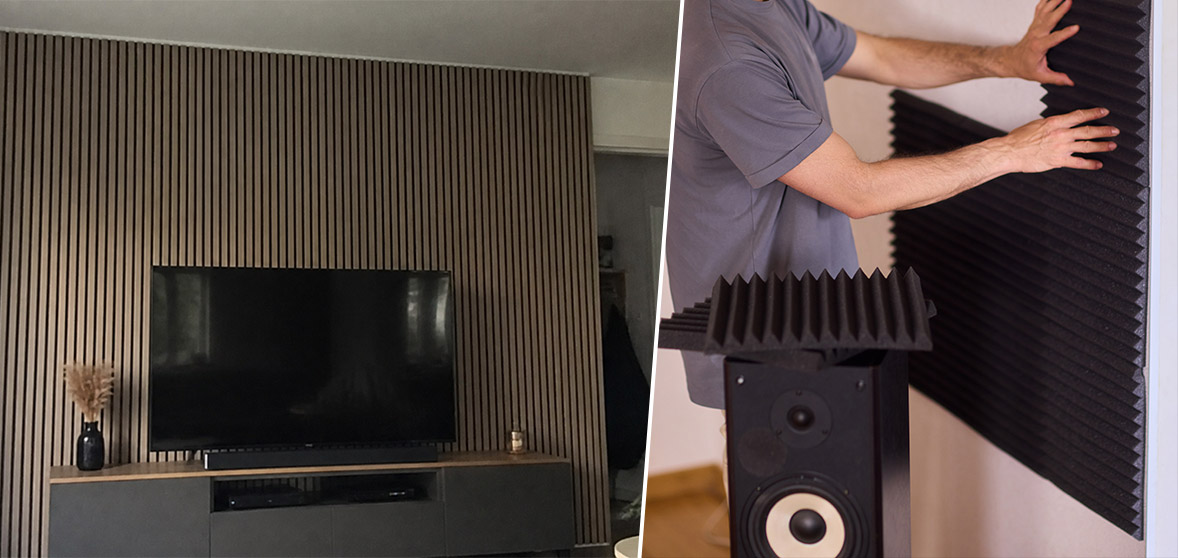
Acoustic panels behind a television (AI-generated), acoustic foam
In this article, you will learn why overly thin acoustic panels won’t help when it comes to acoustic treatment due to simple physical principles – and what actually works instead. But first, let’s start with some basic knowledge to understand how acoustic modules work:
What do acoustic modules do?
Acoustic modules are used, among other things, to reduce the so-called reverberation time in a room. Reverberation is most clearly audible in churches or large halls, but it also occurs in living spaces and offices.
In this video, you can hear the reverberation in a room with and without acoustic modules:
A reverberation time that is too long has many negative effects: For example, it causes poor speech intelligibility, a high noise level within the room, or poor sound from voices, instruments, or speakers. Therefore, an important goal of almost any room acoustic optimization in rooms of all kinds is to reduce this reverberation – and that is exactly what acoustic modules can do.
One of the most important properties of acoustic modules is their so-called absorption coefficient (the α-value), which indicates how well an acoustic module absorbs sound and thus contributes to reducing the reverberation time. However, this is highly dependent on frequency.
Good to know: Everything we hear has its own frequency profile. Low sounds like thunder, bass, or engine noises are characterized by low frequencies – mostly in the range of 250 Hz and below. High sounds like birdsong, flutes, or triangles are characterized by high frequencies, reaching up to the limit of human hearing at around 20,000 Hz.
Frequency = Vibrations of the sound wave per second (in Hertz). The sound frequency determines the pitch.
Acoustic modules do not absorb every pitch equally well. If the effective range of the acoustic module and the “interfering frequencies” match, the acoustic module works and reduces reverberation. But the further apart the effective range and the interfering frequencies are, the less an acoustic module helps. This effective range is significantly influenced by the thickness, the distance from the wall or ceiling, and the material composition of a module. And exactly here lies the problem with thin acoustic panels.
Why Don’t Thin Acoustic Modules Work?
Many thin acoustic modules have a thickness of only 10 to 20 mm, and this is not enough to develop a sufficient effect in low frequencies. You can ignore any additionally attached wood veneers for now; these have no relevant absorption effect but serve primarily visual purposes. The sound-absorbing elements are the soft/porous materials like felt, fleece, or foam. And it is the thickness of this material that matters.
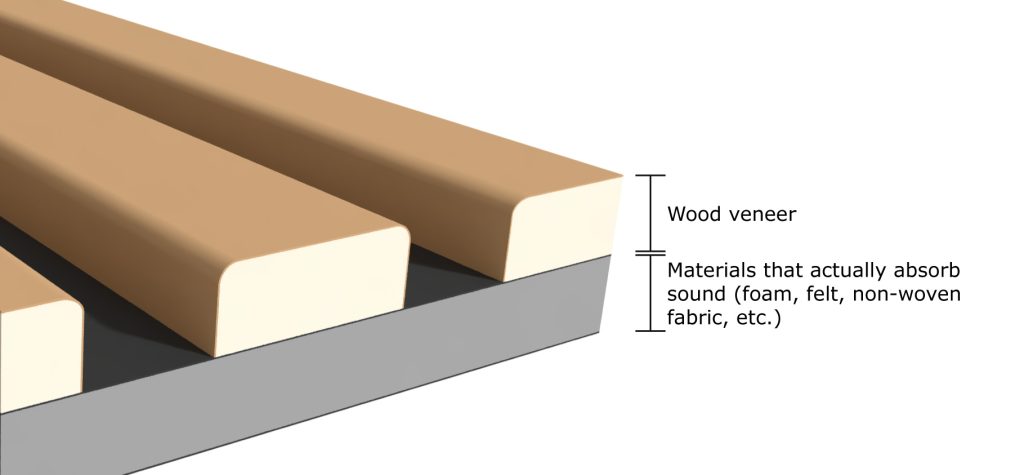
Cross-section of an absorber with wood veneer
Even with a material thickness of 20 mm, an initial, weak absorption effect only begins above 1,000 Hz. Clearly audible, practically relevant absorption with such modules occurs well above that, i.e., from about 3,000 to 4,000 Hz (the quarter-wavelength rule).
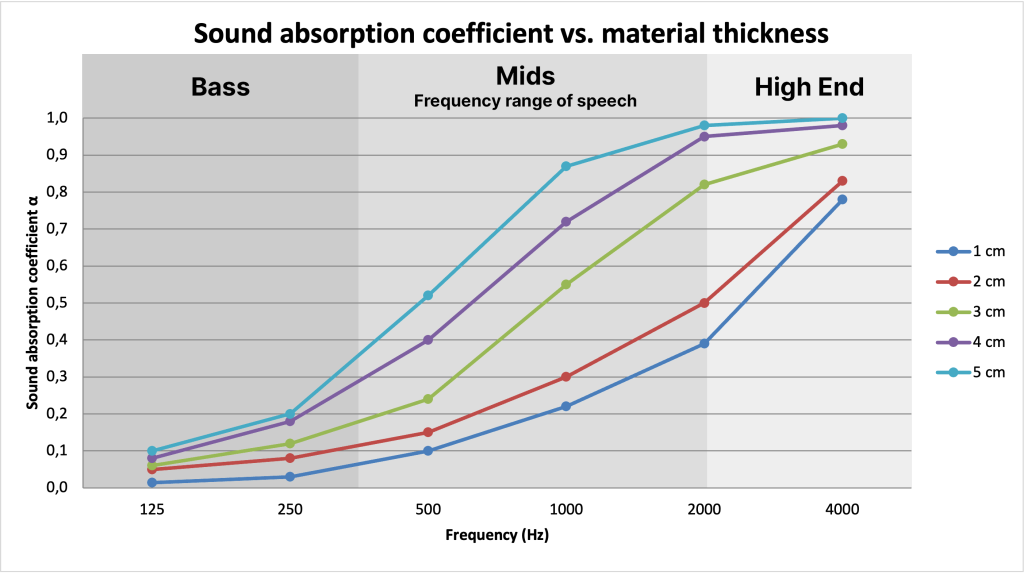
Sound absorption coefficients of absorbing material of various thicknesses – idealized curve for illustration
Human voices, on the other hand, introduce a lot of sound energy into the room even below 500 Hz, and the most important frequency range for good speech intelligibility lies between 1,000 and 2,000 Hz. Televisions, speakers, and radios also generate relevant and loudly audible sound components in this range.
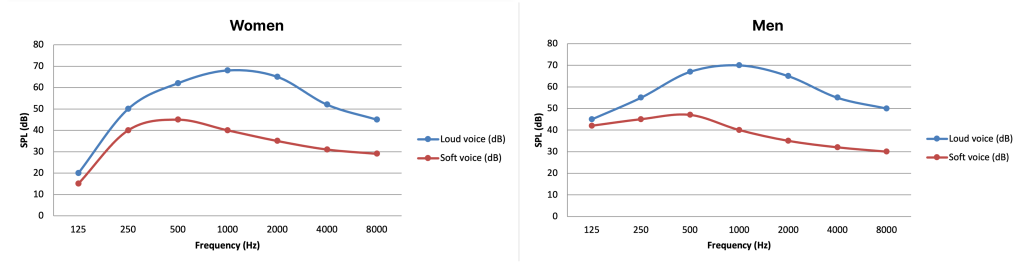
Voice frequencies of women and men (simplified)
This is exactly where the problem described above arises: The effective frequency range of the acoustic panels and the frequencies of human speech as well as other common sounds lie far apart, making the overly thin acoustic modules practically ineffective in this use case.
Quarter-wavelength rule in Room Acoustics: A porous absorber works effectively starting from the frequency at which its thickness (or its distance from the wall) corresponds to a quarter of the wavelength, since the particle velocity is at its maximum there.
Example: The wavelength of 2,000 Hz is 17 cm – ¼ of that is 4.25 cm. So this is the required material thickness (or wall distance) for optimal absorption (absorption also takes place below this, but becomes increasingly weaker).
However, the lack of absorption of low frequencies is only one problem – the other is the over-absorption of high frequencies in the actual effective range of these acoustic modules. A room in which entire walls are covered with wall panels quickly sounds lifeless, muffled, and unnatural. The reverberation of important high, brilliant sound components of speech or music is absorbed excessively and is sometimes missing completely.
The result is a room in which low and mid frequencies continue to create unpleasant reverberation, no acoustic calming occurs, and a muffled sound impression is created.
What Actually Works
The solution lies in so-called broadband absorption, which also covers low frequencies due to the sufficient material thickness of the acoustic module. Suitable acoustic modules should therefore have a high material thickness of 40 mm or more so they can achieve the desired positive effect. This effect can be further improved by mounting the acoustic modules at a distance from the wall or ceiling. The air gap behind the acoustic elements increases the effective range at low frequencies.
Are you looking for acoustic modules that genuinely improve your room’s sound?
Wall Sails, HOFA Ceiling Sails, and HOFA Acoustic Pictures are inexpensive, stylish, and demonstrably effective solutions for optimal room acoustics. Learn more about the HOFA Style-Line here ›
Take a look, for example, at the frequency-dependent absorption coefficient of the HOFA Wall Sails (material thickness 40 mm) at different wall distances:
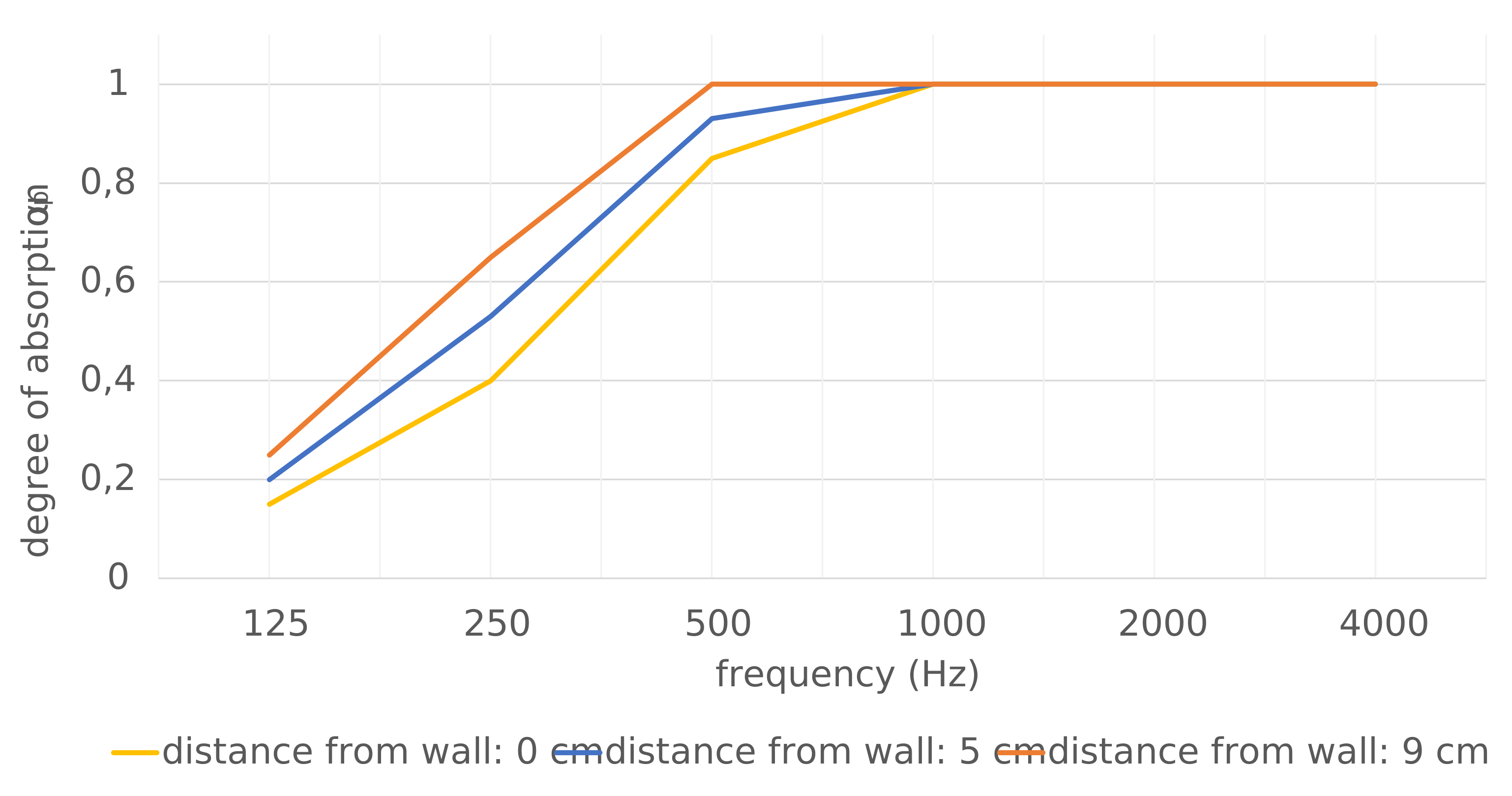
Measurement of sound absorption in a reverberation room according to ISO 354:2003 Practical sound absorption coefficient evaluated according to ISO 11654
Especially for demanding music, studio, and hi-fi applications, the HOFA Studio-Line contains all the modules you need for professional room acoustics.
Another important factor for good room sound is the calculation and targeted acoustic treatment of the room, ensuring that the right amount of acoustic modules is installed in the right places. The positions of seats and furnishings as well as first reflection points play a major role here.
With professional acoustic planning, you avoid expensive bad investments or poor, unbalanced room acoustics. Acoustic planning doesn’t have to be expensive – with the Room Acoustics Planning FREE, you receive room planning from the HOFA acoustic professionals, including reverberation time calculation and visualization, completely free of charge.