

Two common acoustic problems can occur in many rooms: unwanted noise entering from outside and excessive reverberation caused by relatively empty spaces with numerous sound-reflective surfaces. Acoustic curtains can help reduce unwanted noise, minimize reverberation, and improve the overall acoustics of a room. But how do acoustic curtains work, and what should you consider when choosing one? Find out more in this blog post.
What are the benefits of an acoustic curtain?
Reducing noise and improving sound insulation
Acoustic curtains designed for sound insulation combine sound absorption with sound-insulating materials to reduce sound transmission. They are particularly useful in rooms exposed to traffic noise, machinery, or other sources of unwanted external noise.
Reducing reverberation and improving room acoustics
Acoustic curtains designed to improve room acoustics absorb sound and reduce reflections from windows, walls, and other hard surfaces. This reduces reverberation and can improve speech intelligibility, creating a more pleasant acoustic environment.
Acoustic room separation
Acoustic curtains can also provide visual privacy while helping to reduce sound transmission between different areas of a room. This makes them particularly useful in offices, conference rooms, and residential spaces where flexible room separation is required.
Blackout and thermal insulation
When installed in front of windows or glass doors, acoustic curtains can also reduce the amount of sunlight entering a room. Depending on the curtain configuration and fabric used, they can provide effective room darkening and contribute to thermal insulation.
Enhancing the appearance of a room
In addition to their acoustic properties, high-quality acoustic curtains can enhance the interior design of a room. A choice of different colors, high-quality outer fabrics, and optional faux-leather edge protection allows acoustic performance to be combined with an attractive appearance.
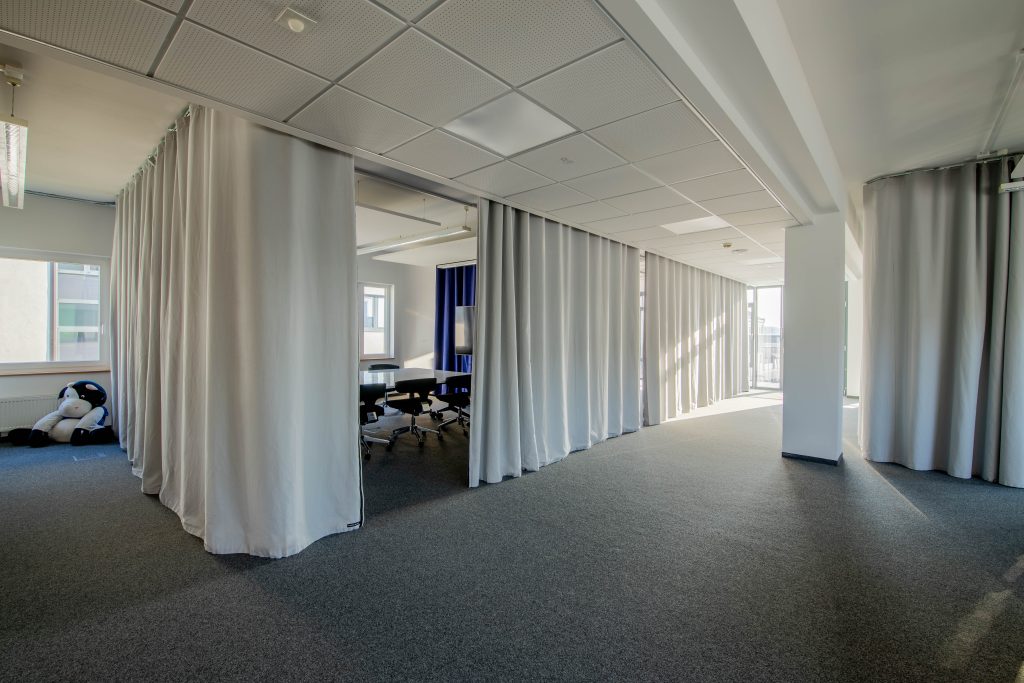
HOFA Acoustic Curtains for optimizing acoustics and flexibly partitioning work areas.
That’s why an acoustic curtain pays off
An acoustic curtain is a versatile solution for improving room acoustics, reducing reverberation, or providing additional sound insulation. Wherever good speech intelligibility and a pleasant acoustic environment are important, acoustic curtains can provide significant benefits.

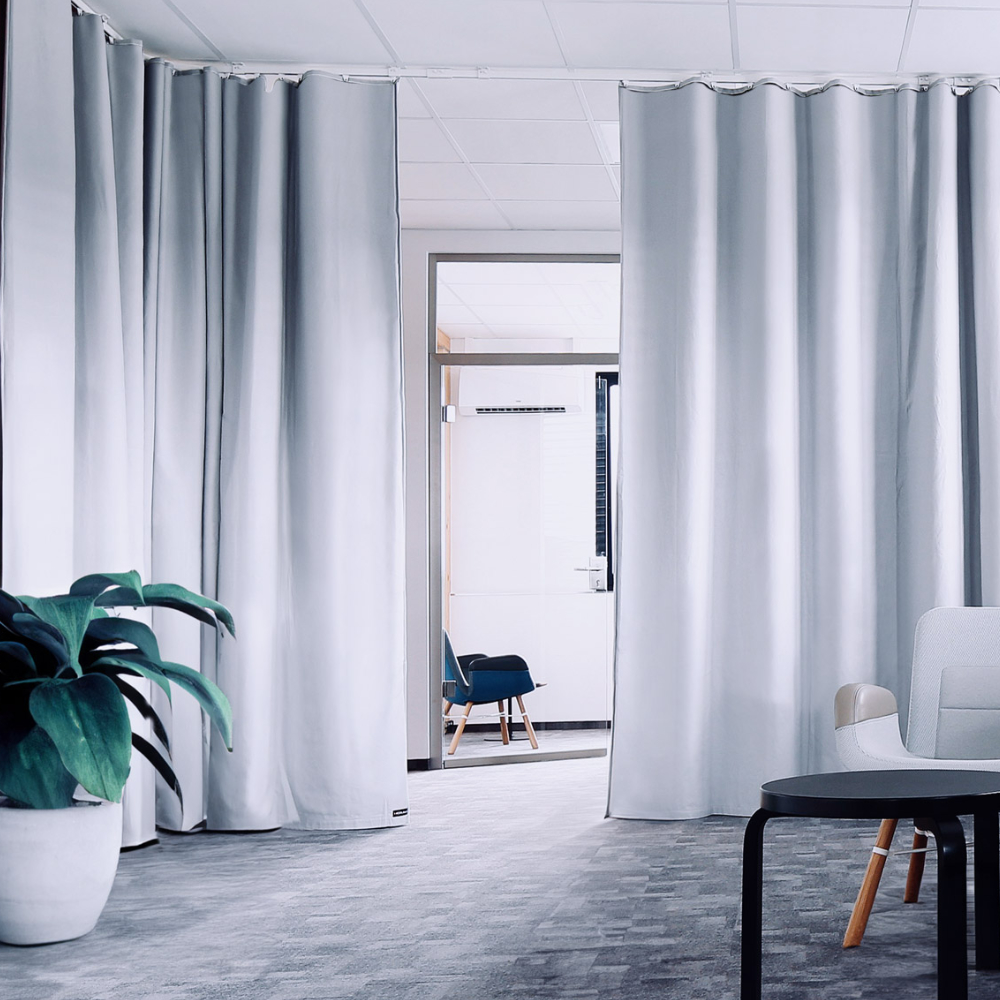
HOFA Acoustic Curtain at a passageway, used to acoustically separate two rooms.
Which acoustic curtain is right for me?
The materials used and their combination play a key role in the acoustic performance of a curtain. High-quality acoustic curtains generally consist of several layers of heavy fabric with a high surface weight and good sound-absorbing properties.
Pay particular attention to the fabric surface weight. Fabrics weighing less than 200 g/m² generally provide only limited acoustic performance. Generally, the higher the surface weight and the more layers incorporated into the curtain, the greater its sound-absorbing performance.
Fabric primarily provides sound absorption and is therefore ideally suited to improving room acoustics. However, fabric alone is not sufficient to provide effective sound insulation. For this purpose, heavy, sound-blocking materials such as PVC films can be incorporated as sound-insulating layers. Combined with the outer fabric layers, these materials create a multi-layer construction that combines sound absorption and sound insulation. The more fabric and insulating film layers are incorporated, the greater the sound-insulating effect. At HOFA-Akustik, we manufacture sound-insulation curtains with up to seven plies. The seven-ply configuration combines four fabric plies with three sound-insulating film plies and is designed for particularly demanding applications.
The size and installation of the curtain also have a significant influence on its acoustic performance. As a rule, the larger the curtain area, the greater its effect on room acoustics. However, it is important to distinguish between a sound-insulating curtain and an acoustic curtain designed to reduce reverberation.
With a sound-insulating curtain, such as the HOFA Acoustic Curtain ISO, the entire area through which unwanted sound may enter should be covered, for example, a window or glass door. The curtain should overlap the area to be covered on all sides and, ideally, extend continuously from floor to ceiling. Gaps or other paths through which sound can travel can significantly reduce the effectiveness of the sound-insulating curtain.
With an acoustic curtain designed to reduce reverberation, such as the HOFA Acoustic Curtain STUDIO, the total absorption area is the key factor. Sound-reflective surfaces such as glass, tiles, solid walls, drywall, and wooden surfaces should be covered as extensively as possible because they reflect sound. With this type of curtain, complete coverage of a surface is not essential. Instead, the general rule is: the larger the curtain area, the greater the acoustic effect. Even with a floating installation that starts a few centimeters above the floor, the acoustic performance remains largely unaffected.

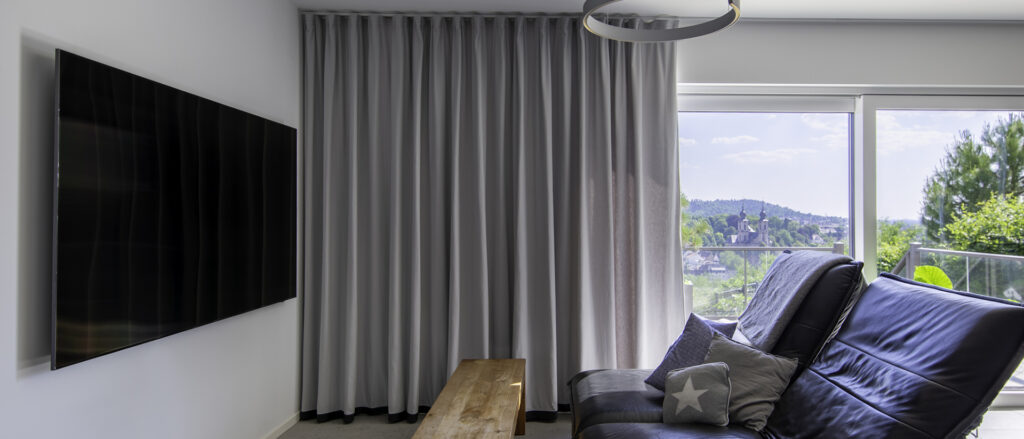
HOFA acoustic curtain in front of a window facade in a living, dining, and workspace area.
It is important to allow for sufficient gathering with all acoustic curtains. The resulting folds or waves are not merely an aesthetic feature—they also increase the effective absorption area and therefore contribute to the acoustic performance. We therefore recommend having reverberation-reducing curtains made twice as wide as the area to be covered – in other words, with a gathering factor of 2. For sound-insulating curtains, a gathering factor of 1.5, i.e. one and a half times the area to be covered, is sufficient.
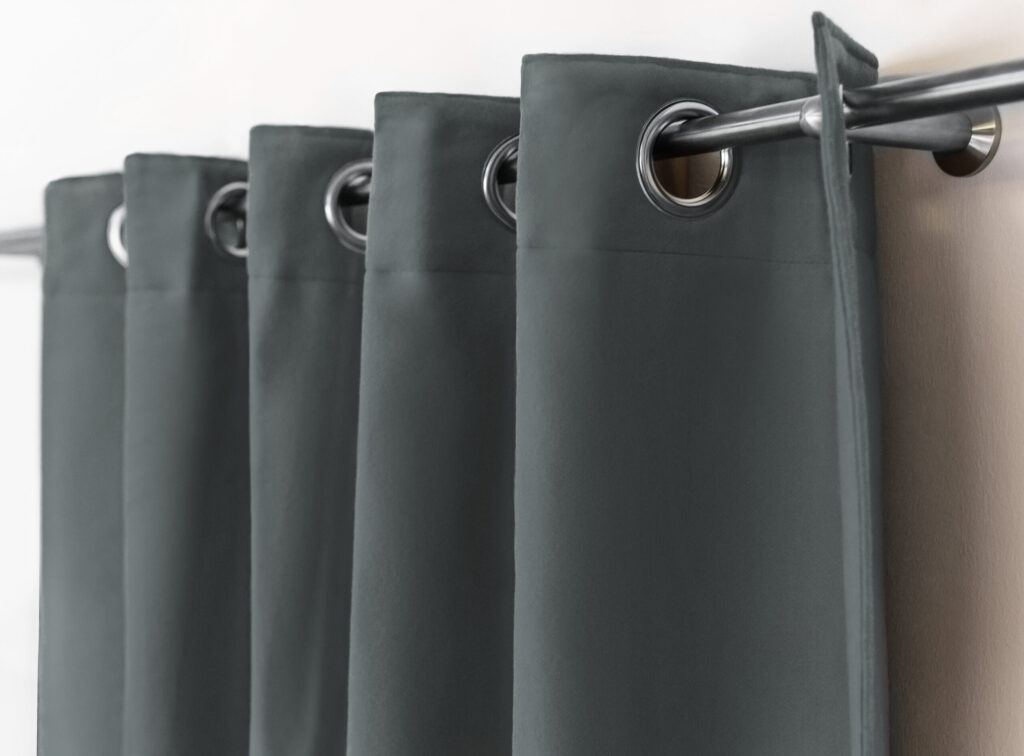
Close-up of a gathered acoustic curtain.
Visual impact
When choosing an acoustic curtain, however, you should consider more than just its acoustic properties. Acoustic curtains can also enhance the visual appeal of living and working spaces. By choosing the right curtain color, a high-quality outer fabric, and optional faux-leather edge protection, you can combine acoustic performance with an attractive design.
Acoustic curtains can also provide additional benefits such as room darkening and thermal insulation. When it comes to blackout performance, it is important to note that standard acoustic curtains already absorb a significant amount of light. However, particularly in direct sunlight and with a small number of plies, some light may still pass through.
Incorporating a so-called Dimout fabric can help. This fabric does not provide significant acoustic absorption, but it considerably reduces light transmission and can create very dark rooms even during daylight hours.
Installing an acoustic curtain correctly

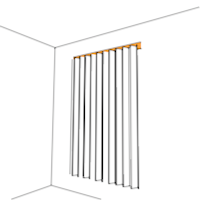
Correct installation has a decisive influence on the performance of an acoustic curtain. In addition to its position, the mounting system and suspension method also play an important role.
Whether ceiling mounting or wall mounting is the better option depends on the structural conditions.
In many cases, ceiling mounting with a curtain track is the preferred solution. The curtain is suspended from the track using curtain tape and rollers, making it easy to open, close, or move as required. Particularly heavy curtains are also generally more securely supported when mounted to the ceiling. Ceiling mounting can also improve sound insulation because it avoids eyelets and minimizes additional openings through which sound could pass. If the ceiling is made of drywall or is a suspended ceiling, however, its load-bearing capacity may be insufficient. In this case, a suitable substructure may be required, or the curtain must be attached to the load-bearing structural ceiling.
Wall mounting provides a practical alternative to ceiling mounting. Depending on the installation situation, the curtain can be attached using a sturdy curtain rod or a wall-mounted curtain track with rollers. Always make sure to use high-quality, load-bearing curtain systems, or use the systems from HOFA-Akustik. Heavy acoustic curtains require sturdy rods, tracks, and brackets to prevent them from bending, becoming detached, or failing over time. If you have any questions about planning or installation, our HOFA acoustics experts will be happy to assist you. Together with our installation partners, we can also arrange professional installation on request—particularly for demanding projects.
Ceiling installation of a HOFA Acoustic Curtain with rails.
Find the right acoustic curtain with HOFA
Are you looking for a sound-insulating curtain or an acoustic curtain for reducing reverberation? Then you have come to the right place.
For more than 15 years, we have been optimizing the acoustics of a wide range of spaces – from small rehearsal rooms to large industrial and assembly halls. Thanks to our in-house sewing workshop, we manufacture every acoustic curtain individually according to your requirements.
The HOFA Acoustic Curtain ISO was specifically developed for sound insulation. It is available in three, five, or seven plies and combines heavy acoustic fabric with sound-insulating film. Depending on the configuration, the curtain achieves sound insulation of up to 17 dB.

Sound insulation rating for HOFA Acoustic Curtain ISO 3. At 1 kHz, the sound insulation is 11 dB.
For improving room acoustics and reducing reverberation, we recommend the HOFA Acoustic Curtain STUDIO. It consists exclusively of heavy acoustic fabric and is available as STUDIO 2 or STUDIO 3, with two or three fabric plies respectively.
Simply let us know what type of unwanted noise or acoustic problem you want to address, what dimensions are required, and what materials your walls and ceiling are made of. We will help you find the right configuration for your requirements. Alternatively, you can use our acoustic curtain configurator to configure your individual curtain and select the appropriate mounting system directly.
Watch the following video to find out just how effective the HOFA ISO 7 Acoustic Curtain is at blocking out disruptive ambient noise:
Do you have questions about our acoustic modules or would you like a personalized consultation?
Just get in touch with us. We’d be happy to advise you personally and create a customized room acoustics planning for you.